









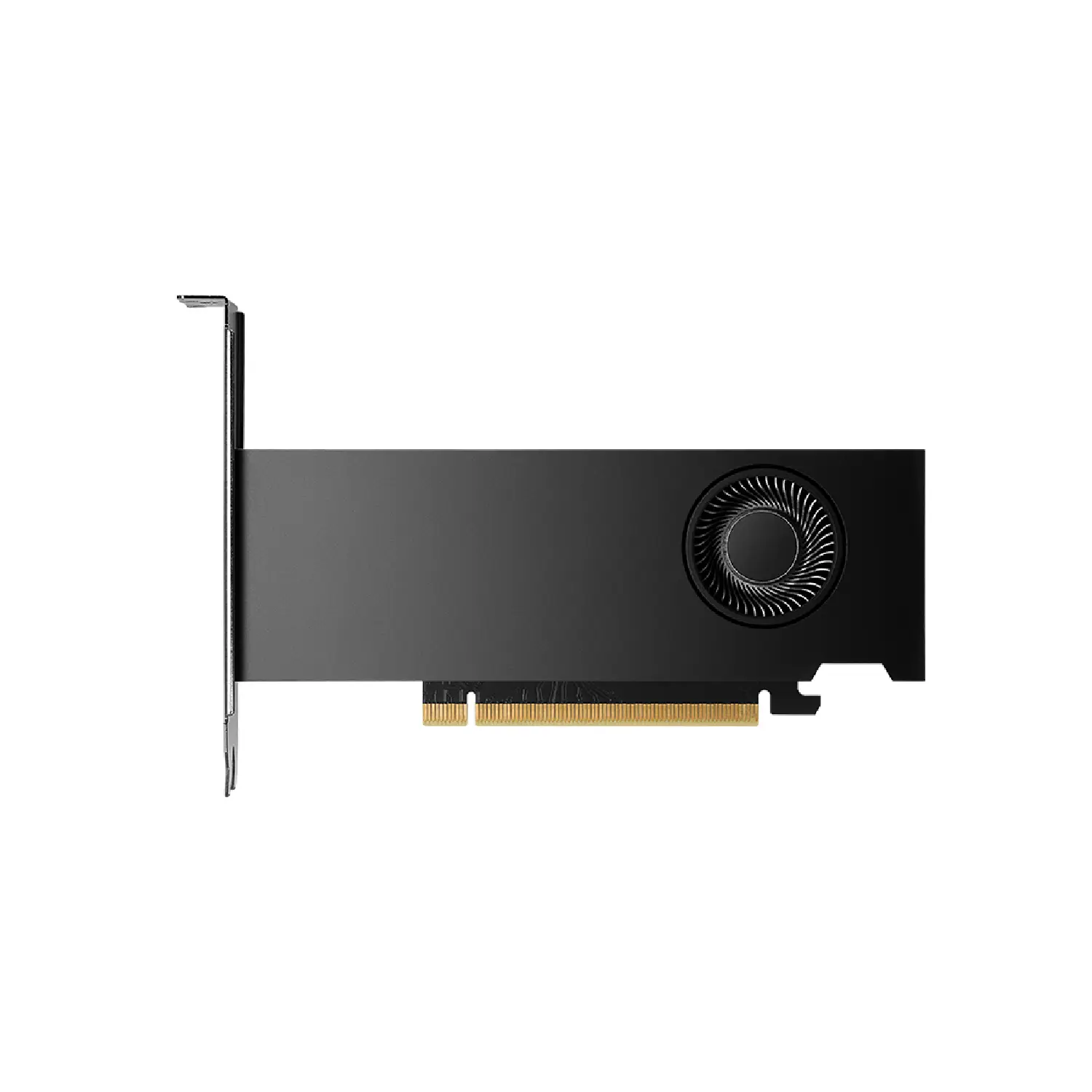
PNY Nvidia RTX A2000 ADA Generation 16GB GDDR6 Professional Workstation Display card
- NVIDIA Ada Lovelace Architecture
- 4 nm NVIDIA Custom Process
- 19.9 Billion Transistors
- 88 Tensor Cores
- 16 GB GDDR6 with ECC GPU Memory
- 96 GB GDDR7 with ECCGPU Memoryy
- Max Power Consumption 70 W
Free Shipping
Zero delivery charges, maximum convenience.
If You Have Any Query,
Please Contact Us
Our Sales Specialist
Name: Anjalina
Physical Store Available
100% Genuine
24/7 Support

Description
NVIDIA Ada Lovelace Architecture
The NVIDIA RTX™ 2000 Ada Generation, based on the Ada Lovelace architecture, gives professionals the power of the latest RTX technology for accelerated ray tracing and AI to drive advanced visualization, creative, and design workflows for mainstream applications.
CUDA Cores
The NVIDIA Ada Lovelace architecture-based CUDA Cores deliver up to 1.5X the single-precision floating-point (FP32) throughput compared to the previous generation, providing significant performance improvements for graphics workflows such as 3D model development and single-precision compute for workloads like desktop simulation for CAE.
Third-Generation RT Cores
Third-generation RT cores in the RTX 2000 provide up to 1.7X faster ray tracing performance over the previous generation, significantly boosting rendering speeds for content creation, design reviews, and virtual manufacturing prototyping. Enhanced RT cores and Shader Execution Reordering (SER) technology optimize shader performance, further accelerating ray traced image rendering.
Fourth Generation Tensor Cores
Fourth-generation Tensor Cores provide support for the new FP8 data format for inference providing up to 1.8X higher throughput for tensor matrix operations than the previous generation and reducing data memory usage by half compared to the FP16 data format for more efficient execution of workloads using a mix of computation and addressing calculations.
PCIe Gen 4
The RTX 2000 supports PCIe Gen 4, which doubles the bandwidth of PCIe Gen3 from 15.75GB/sec to 31.5 GB/sec for x8 connections, improving data transfer speeds from CPU memory for data-intensive tasks such as AI, data science, and creating 3D models from large datasets. RTX 2000 Ada Generation utilizes a full-length PCIe Gen 4 x8 interface.
Higher Speed GDDR6 Memory
The RTX 2000 features 16GB of GDDR6 memory, providing the memory needed for rendering, data science, engineering simulation, and other GPU memory-intensive applications. Support for ECC memory delivers uncompromised computing accuracy and reliability for mission-critical applications.
Error Correcting Code (ECC) on Graphics Memory
ECC on graphics memory detects and corrects data corruption in memory, meeting strict data integrity requirements for mission-critical applications with uncompromised computing accuracy and reliability for workstations.
Fifth-Generation NVDEC Engine
NVDEC is well-suited for transcoding and video playback applications for real-time decoding. The following codecs are supported for hardware-accelerated decoding: MPEG-2, VC-1, H.264 (AVCHD), H.265 (HEVC), VP8, VP9, and AV1.
Eighth-Generation NVENC Engine
NVENC can take on the most demanding 4K or 8K video encoding tasks to free up the graphics engine and the CPU for other operations. The RTX 2000 provides better encoding quality than software-based x264 encoders. The RTX 2000 incorporates AV1 video encoding which is 40% more efficient than H.264 encoding for 4K HDR video. AV1 will provide better quality at the same bitrate bandwidth.
Graphics Preemption
Pixel-level preemption provides more granular control to better support time-sensitive tasks such as VR motion tracking.
Compute Preemption
Preemption at the instruction level provides finer grain control over compute tasks to prevent long-running applications from either monopolizing system resources or timing out.
NVIDIA RTX IO
Accelerating GPU-based lossless decompression performance by up to 100x and 20x lower CPU utilization compared to traditional storage APIs using Microsoft’s new DirectStorage for Windows API. RTX IO moves data from the storage to the GPU in a more efficient, compressed form, and improves I/O performance.
| Architecture | NVIDIA Ada Generation Architecture |
| Process Size | 4N NVIDIA Custom Process |
| Transistors | 19.9 Billion |
| Die Size | 159 mm |
| CUDA Cores | 2816 |
| Tensor Cores | 88 |
| RT Cores | 22 |
| Single-Precision Performance | 12 TFLOPS |
| RT Core Performance | 27.7 TFLOPS |
| Tensor Performance | 191.9 TFLOPS |
| GPU Memory | 16 GB GDDR6 with ECC |
| Memory Interface | 128-bit |
| Memory Bandwidth | 224 GB/sec |
| display connectors | 4x Mini DisplayPort 1.4a |
| NVENC | NVDEC | 1x | 1x (+ AV1 encode & decode) |
| System Interface | PCI Express 4.0 x8 |
| NVLink | Not Supported |
| Form Factor | 2.7” H x 6.6” L Dual Slot |
| Thermal Solution | Blower Active Fan |
| Maximum Power Consumption | 70 W |
| Max Digital Resolution | 7680 x 4320 x36 bpp at 60 Hz |